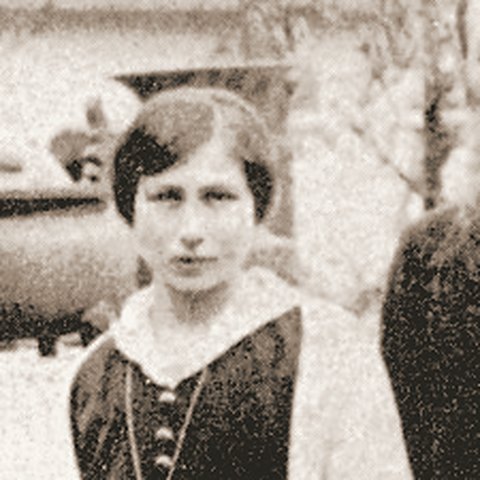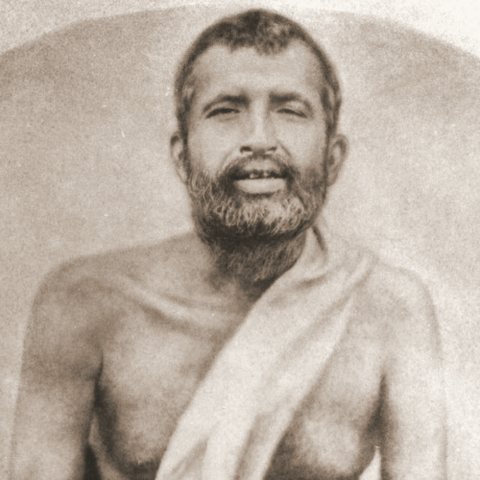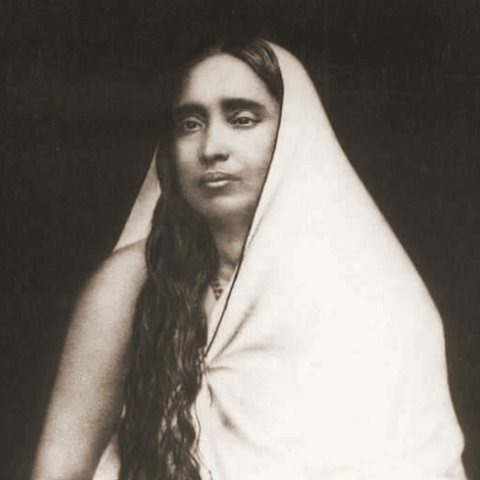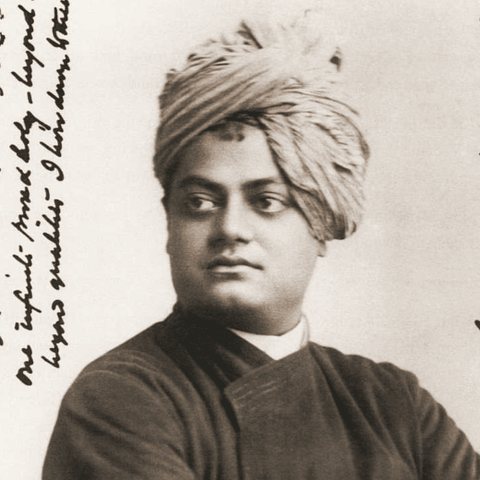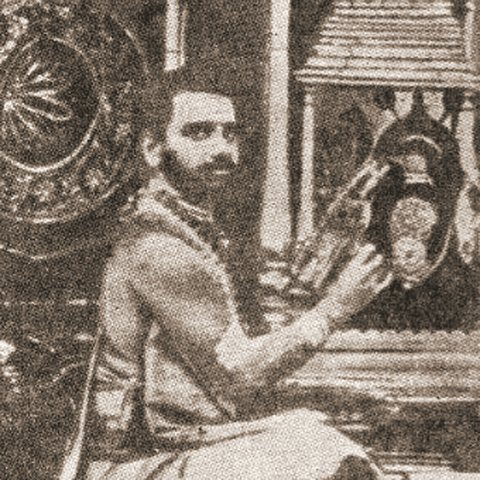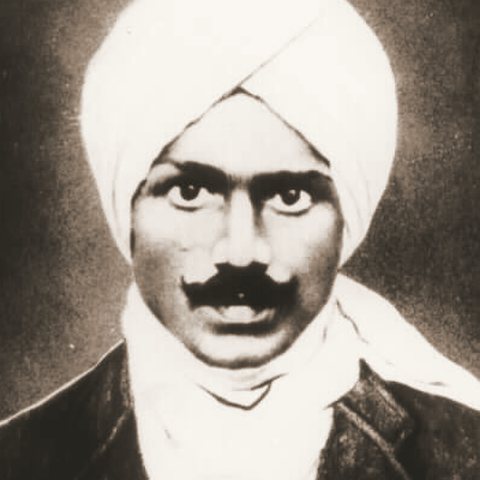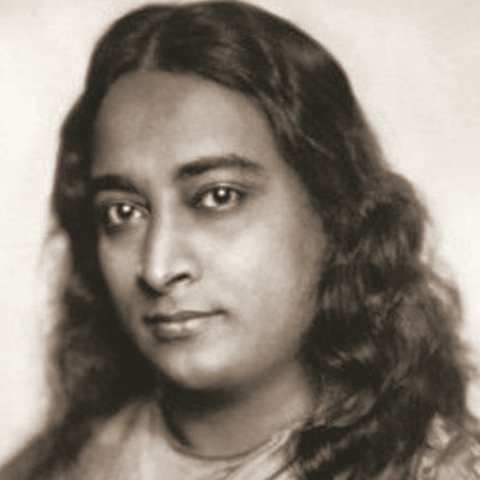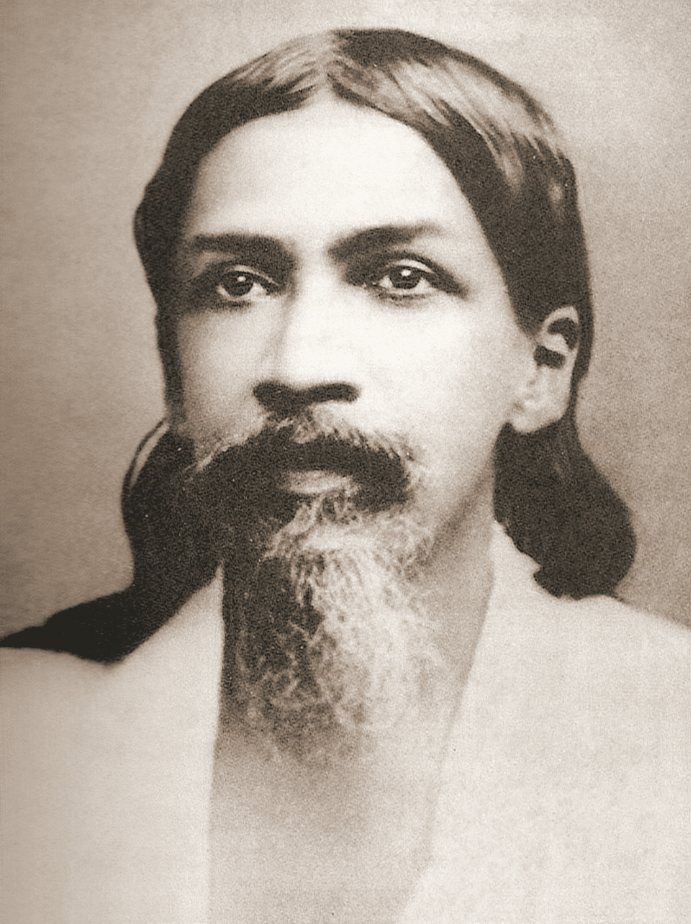
Sri Aurobindo, c. 1900. Public domain, via Wikimedia Commons.
Sri Aurobindo
Poet, revolutionary, yogi of the future
Sri Aurobindo is the one figure in this library who was, in turn, a Cambridge classicist, a nationalist agitator jailed for sedition, and then—for forty years, in silence, in Pondicherry—a yogi attempting something no tradition had attempted before. He accepted the goal of the old yogas, liberation, and then asked for more: that the higher consciousness come down into mind, life and body, so that a divine life becomes possible on earth rather than only after it.
His writing is vast and difficult, but the practical core is small. Aspire. Reject what contradicts the aspiration. Surrender the rest. And do all of it inside ordinary life—work, family, illness, art—because for him nothing was outside the field of yoga.
“Courage and love are the only indispensable virtues; even if all the others are eclipsed or fall asleep, these two will save the soul alive.”
Integral Yoga
Most yogas seek release from the world. Integral Yoga accepts release as the first step and then asks for something further: that mind, life and body be remade by a higher consciousness, so that a divine life becomes possible on earth. It is integral in two senses—it takes up the whole person, and it takes up the whole of life as its field. There is no fixed ritual, no compulsory scripture, no single technique; the essential movement is a turning of the whole being towards the Divine and a consent to be changed.
The psychic being
Behind the heart, Sri Aurobindo says, is the soul—a spark of the Divine that grows across lives into a personality of its own. It is not the mind, not the emotions, not the vital energy, not the ego. It is the one part of us never corrupted, never afraid, never in doubt, recognisable by a quiet unforced sweetness and a spontaneous turning toward truth. The first practical aim of the yoga is to bring this being “from behind to the front,” so that it, rather than the mind or the desires, governs the life.
Aspiration, rejection, surrender
These are the three simultaneous movements of the daily work. Aspiration is the call of the being upward—a yearning turned toward the Divine, and, he insists, an act of will available at any moment. Rejection is the steady refusal of whatever contradicts that call: not suppression, which only holds a movement down, but detachment and dismissal. Surrender is the handing over of oneself and one's works. The three are one act seen from three sides, and none of them is a single decision—all are lifelong.
The evolution of consciousness
Consciousness is not produced by matter; it was involved in it from the beginning, and Nature is slowly bringing it out—first as life in the plant, then as mind in the animal and the human. The human being is therefore not the end of the process but a transitional creature: the first able to collaborate consciously in its own further evolution. Above mind, Sri Aurobindo says, is a different kind of knowing altogether, which he called the Supermind or Truth-Consciousness, and the descent of that power is the work the yoga aims at.
The four powers of the Mother
In his small book The Mother (1928) he describes four personalities through which the one divine Shakti works: Maheshwari, wisdom and wideness; Mahakali, force and speed that will not tolerate falsehood or delay; Mahalakshmi, beauty, harmony and the charm that draws the heart; and Mahasaraswati, the power of work, patience and exact attention to the smallest detail. Each answers to a different need in the seeker, and the yoga asks for all four.
Courage and love are the only indispensable virtues; even if all the others are eclipsed or fall asleep, these two will save the soul alive.
If you want to do Yoga, you must get rid of fear. Yoga and fear do not go together.
One must learn to take one's foundation on the Divine and overcome the fear, relying on the help to carry one through all things even unpleasant and adverse.
If you give expression to anger, you prolong or confirm the habit of the recurrence of anger; you do not diminish or get rid of the habit.
When they come, you must stand back from them in your mind, look at them and say, “I don't want this.”
Hate not the oppressor, for, if he is strong, thy hate increases his force of resistance; if he is weak, thy hate was needless.
The mind may be a shifting sea of doubts and yet that faith may be there within and, if so, it will keep even the doubt-racked mind in the way.
They proved to me by convincing reasons that God did not exist, and I believed them. Afterwards I saw God, for He came and embraced me. And now which am I to believe, the reasonings of others or my own experience?
It is the spirit and the consciousness in which it is done that makes an action Yogic—it is not the action itself.
Poets make much of death and external afflictions; but the only tragedies are the soul's failures and the only epic man's triumphant ascent towards godhead.
Not to get discouraged when there is no immediate result is very important—for then the force within sinks.
One should go on steadily whether the pace is slow or hampered or swift and easy—one will always get to the goal in time.
The tragedies of the heart & the body are the weeping of children over their little griefs & their broken toys. Smile within thyself, but comfort the children; join also, if thou canst, in their play.
Aspiration is an act of the will and one can always aspire.
The Divine gives itself to those who give themselves without reserve and in all their parts to the Divine.
The rejection of desire is essentially the rejection of the element of craving, putting that out from the consciousness itself as a foreign element not belonging to the true self and the inner nature.
Late, I learned that when reason died, then Wisdom was born; before that liberation, I had only knowledge.
God had opened my eyes; for I saw the nobility of the vulgar, the attractiveness of the repellent, the perfection of the maimed and the beauty of the hideous.
I am not a Bhakta, I am not a Jnani, I am not a worker for the Lord. What am I then? A tool in the hands of my Master, a flute blown upon by the divine Herd-Boy, a leaf driven by the breath of the Lord.
There are two powers that alone can effect in their conjunction the great and difficult thing which is the aim of our endeavour, a fixed and unfailing aspiration that calls from below and a supreme Grace from above that answers.
It is always this psychic being that is the real, though often the secret cause of man's turning to the spiritual life and his greatest help in it. It is therefore that which we have to bring from behind to the front in the Yoga.
Let the sweetness and the happy feeling increase, for they are the strongest sign of the soul, the psychic being awake.
Fear is a creation of the vital plane, an instinct of the ignorance, a sense of danger with a violent vital reaction that replaces and usually prevents or distorts the intelligence of things.
Concentration in the heart
- Sit quietly. Gather your attention and place it in the centre of the chest, behind the breastbone—what Sri Aurobindo calls the heart-centre, the seat of the soul.
- Hold it there. When it drifts to the head, or out to the room, bring it back without irritation. Effort is normal at first; later, he says, it becomes spontaneous.
- Add a wordless call—for peace, for light, for the Divine. Do not try to feel anything. Simply keep the attention there and the call alive.
- Ten minutes is enough to begin. The sign of progress is not a vision but a growing quiet sweetness.
Standing back from a reaction
- When anger, fear or craving rises, do not act on it and do not fight it. Take one step back inside and watch it arrive, as a movement passing through you rather than as you.
- Name it plainly: “this is anger.” Then say, in his exact words, “I don't want this.”
- Do not expect it to vanish. It will return. Each time, stand back and refuse again. What weakens the habit is the refusal, not the victory.
Offering the work
- Before beginning any task, offer it—silently, in a sentence or without words.
- Do it as well and as exactly as you can, for its own perfection, without demanding a result for yourself or insisting that it be noticed.
- When it is finished, offer the outcome too, whatever it is. Done this way, he says, the work itself becomes the yoga.
Born Aurobindo Ghose in Calcutta on 15 August 1872, he was sent to England at seven and educated entirely in the West—St Paul's School and King's College, Cambridge—cut off by his father's design from Indian religion and languages. He returned in 1893 and spent thirteen years in the princely state of Baroda, teaching, learning Sanskrit and Bengali, and beginning, in 1905, the practice of yoga.
After the partition of Bengal he became one of the first Indian leaders to demand complete independence rather than reform, chiefly through the newspaper Bande Mataram. Arrested in the Alipore Bomb Case, he spent a year in custody, during which he underwent the spiritual experiences he later described as decisive. In 1910 he withdrew from politics to French Pondicherry and never left it. From 1914 to 1921 he published the monthly Arya, in which nearly all his major prose first appeared: The Life Divine, The Synthesis of Yoga, Essays on the Gita, The Secret of the Veda.
In 1926, with the Mother, he founded the Sri Aurobindo Ashram. He then lived in seclusion, writing tens of thousands of letters of guidance to disciples and composing the epic poem Savitri. He left his body on 5 December 1950.
All quotations are from the Complete Works of Sri Aurobindo as published online by the Sri Aurobindo Ashram Trust, Pondicherry, and each links to the chapter it comes from. Works published in his lifetime are in the public domain in India; later-published works and the edited Complete Works remain the Trust's copyright. We reproduce only short attributed excerpts and link to the Ashram's own library for the rest. This site is not affiliated with or endorsed by the Sri Aurobindo Ashram.