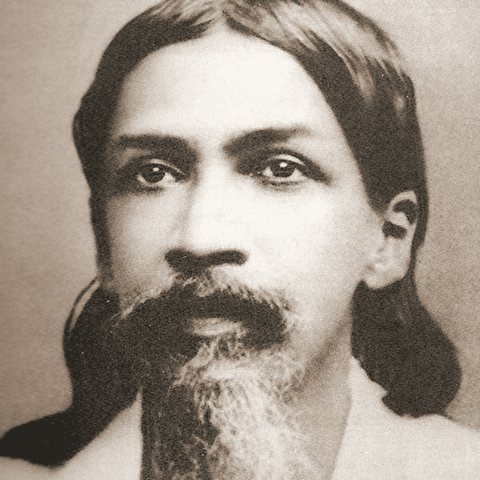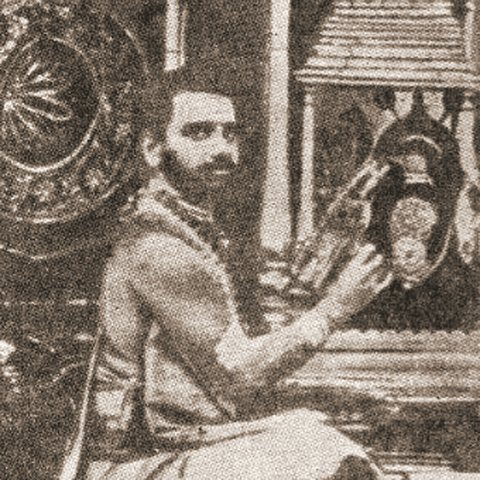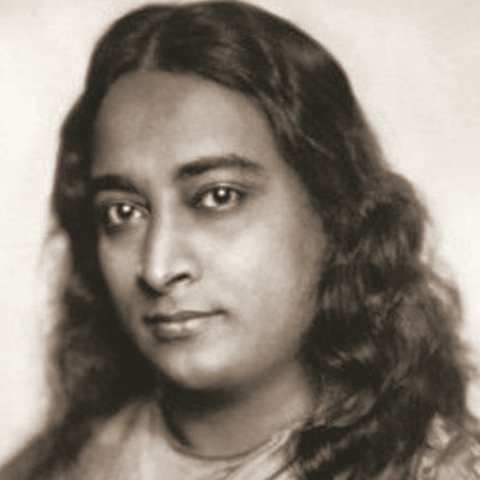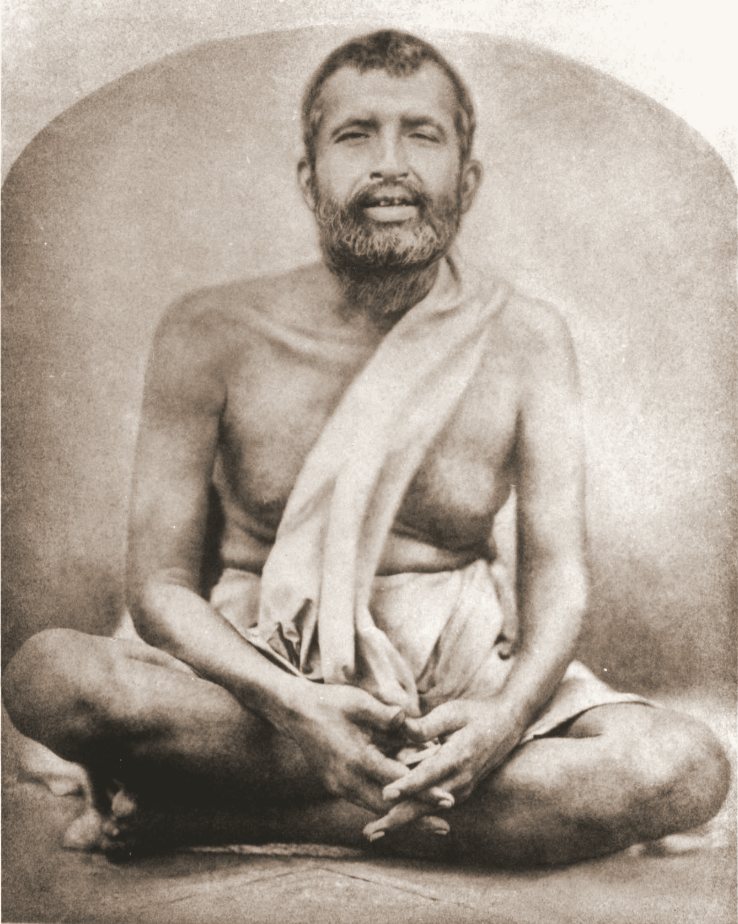
Sri Ramakrishna at Dakshineswar, October 1885. Public domain, via Wikimedia Commons.
Sri Ramakrishna
The priest of Dakshineswar who practised every path and found one God
A temple priest with almost no schooling, who taught in the homely parables of village Bengal—salt dolls, mango orchards, kittens, chameleons—and whose conversations, taken down in shorthand by a schoolmaster who sat at his feet, became one of the great religious documents of the modern world. Sri Ramakrishna did not argue his way to religious harmony; he practised his way to it, taking up one discipline after another over thirteen years and finding that “the substance is one under different names.”
What he asked of people was not belief but longing. “Weep for God with a longing heart,” he said, and meant it literally. He died of throat cancer at fifty, refusing to pray for his own cure, surrounded by the young men who would become the Ramakrishna Order.
“God can be realized through all paths. All religions are true.”
As many faiths, so many paths
Yato mat, tato path. Different religions are different ghats on the same lake, different paths up the same hill. This was not theory for him but testimony: he had gone up several of the paths himself. Yet he also warned against hopping from faith to faith—“you must stick to one path with all your strength”—because the point is to reach the roof, not to admire the staircases.
Longing is the qualification
Not learning, not caste, not moral record. “One attains God when one feels yearning for Him. An intense restlessness is needed.” He compared knowledge without love to a rocket that throws off a few sparks and dies, and prayed himself only for love—“here is Thy ignorance and here is Thy knowledge; take them both and give me pure love for Thee.”
The Divine Mother
For Ramakrishna, Kali was not a tribal goddess but the Ultimate Reality regarded as personal, active and maternal—the same Brahman that Vedanta calls attributeless, approached as Mother. He held that God with form and God without form are equally true, that the clay image is a doorway, and that the relationship of child to mother is the most natural a human being can take toward God. One may complain to a mother.
Lust and gold
He named two appetites that bind consciousness: kāminī-kāñcana, rendered in the standard English translation as “woman and gold” but meaning, as the Order's own later publications correct it, lust and greed. He was speaking to male monastic aspirants, and warned women devotees against “man and gold” in the same breath. His own commentary is the Kartikeya parable, below: “I consider every woman as my Divine Mother.”
Living in the world
He did not ask householders to leave. “Do all your duties, but keep your mind on God.” His image is the jackfruit: rub oil on your hands first and the sticky sap will not cling. Or butter and water: raw milk poured into water is lost, but butter churned from it floats. A mind first churned by practice can live in the world untouched.
God can be realized through all paths. All religions are true.
God is one, but His names are many.
You must stick to one path with all your strength. A man can reach the roof of a house by stone stairs or a ladder or a rope-ladder or a rope or even by a bamboo pole.
One attains God when one feels yearning for Him. An intense restlessness is needed.
Weep for God with a longing heart. Tears shed for Him will wash away the clay.
Be like a kitten and cry to Him with a fervent heart. The mother cat puts the kitten wherever she wants to.
I ask people to live in the world in a spirit of detachment. If you break the jack-fruit after rubbing oil on your hands, its sticky juice will not smear them.
If you put milk in water the milk is spoiled. But this will not happen if butter, churned from the milk, is put in water.
The body has, indeed, only a momentary existence. God alone is real.
I am but Thy child. I am easily worried and frightened. I want a Mother.
Only when a man says: “Not I! Not I! I am nobody. O Lord, Thou art the Doer and I am Thy servant” is he freed from all sufferings.
Reality is One: Sages call It by various names.
Where will you find God except in man? Man is the highest manifestation of the Divine.
One cannot have the vision of God as long as one has these three — shame, hatred, and fear.
The heart of the devotee is the abode of God.
He is born in vain who, having attained the human birth, so difficult to get, does not attempt to realize God in this very life.
A man should do his worldly duties with only twenty-five per cent of his mind, devoting the rest to God.
I prayed to the Divine Mother only for love. I offered flowers at Her Lotus Feet and said with folded hands: “O Mother, here is Thy ignorance and here is Thy knowledge; take them both and give me pure love for Thee.”
Suppose there is an error in worshipping the clay image; doesn't God know that through it He alone is being invoked? He will be pleased with that very worship.
You may try thousands of times, but nothing can be achieved without God's grace.
The salt doll
Once, a salt doll went to measure the depth of the ocean. It wanted to tell others how deep it was. But this it could never do, for no sooner did it get into the water than it melted. Now, who was there to report the ocean's depth? What Brahman is cannot be described. In samadhi one attains the knowledge of Brahman — one realises Brahman. In that state reasoning stops altogether, and man becomes mute. He has no power to describe the nature of Brahman.
The four friends and the wall
Once four friends, in the course of a walk, saw a place enclosed by a wall. The wall was very high. They all became eager to know what was inside. One of them climbed to the top of the wall. What he saw on looking inside made him speechless with wonder. He only cried, “Ah! Ah!” and dropped in. He could not give any information about what he saw. The others too climbed the wall, uttered the same cry, “Ah! Ah!” and jumped in. Now who could tell what was inside! What Brahman is cannot be described. Even he who knows it cannot talk about it.
The ant and the sugar hill
Men often think they have understood Brahman fully. Once, an ant went to a sugar hill. One grain filled its stomach. Taking another grain in its mouth it started homeward. On its way it thought, “Next time I shall carry home the whole hill.” That is the way shallow minds think. They don't know that Brahman is beyond one's words and thought. However great a man may be, how much can he know of Brahman? Sukadeva and sages like him may have been big ants; but even they at the utmost could carry eight or ten grains of sugar!
Kartikeya and the cat
Kartikeya one day happened to scratch a cat with his nail. On going home, he saw that there was the mark of a scratch on the cheek of his Divine Mother, Parvati. Seeing this he asked her, “Mother, how did you get this ugly scratch on your cheek?” The mother of the universe replied, “This is the work of your own hand; it is the scratch of your nail.” Kartikeya asked in wonder: “How is it, Mother? I do not remember to have scratched you at any time.” The Mother replied, “Darling, have you forgotten the fact of your having scratched a cat this morning?” Kartikeya said, “Yes, I did scratch a cat, but how did your cheek get the scar?” The Mother replied, “Dear child, nothing exists in this world but Myself. The whole creation is Myself; whomsoever you may hurt, you only hurt me.” Kartikeya was greatly surprised to hear this; and then he determined never to marry. For, whom could he marry? Every woman was mother to him. Realizing thus the motherhood of woman, he gave up marriage. I am like Kartikeya. I consider every woman as my Divine Mother.
The Homa bird
The Vedas speak of the Homa bird. It lives very high in the sky. There the mother bird lays her egg. She lives so high that the egg falls for many days. While falling it is hatched. The chick continues to fall. That also goes on for many days. In the meantime the chick develops eyes. Coming near the earth, it becomes conscious of the world. It realises it will meet certain death if it hits the ground. Then it gives a shrill cry and shoots up towards its mother. The earth means death, and it frightens the young bird; it then seeks its mother. She dwells high up in the sky, and the young bird shoots straight up in that direction. It doesn't look anywhere else. Persons who are born with God-consciousness realise the danger of coming in contact with the world. From their very childhood they are afraid of the world, and their one thought is how to reach the mother, how to realise God.
Calling with longing
- Choose one name or one form of God—any that you already love, or that your family loved. He was emphatic that it does not matter which.
- Sit, or walk, or lie down, and call. Not politely. He asked for the cry of a kitten, of a child for its mother—“an intense restlessness.”
- If tears come, let them. He held that tears shed for God do the work that years of argument cannot.
- Do this daily, briefly, and stick to the one path. Do not switch names when it gets hard.
Oil on the hands
- Before going into a demanding situation—a family argument, a difficult day at work, a negotiation—take two minutes alone.
- Remember, deliberately, that the people involved and the outcome do not ultimately belong to you. He said: “know in your heart of hearts that they do not belong to you.”
- Then go in and do your full duty. The remembrance is the oil; the situation is the jackfruit. The sap will not cling.
Born Gadadhar Chattopadhyay on 18 February 1836 in Kamarpukur, a village in Bengal, to a poor and orthodox Brahmin family, he refused what he called “bread-winning education” and showed spiritual absorption from childhood. Around 1856 he became priest of the newly built Kali temple at Dakshineswar, north of Calcutta, and there entered a period of extreme longing that culminated in his first vision of the Divine Mother—the whole visible world dissolving into “a limitless, infinite, effulgent Ocean of Consciousness.”
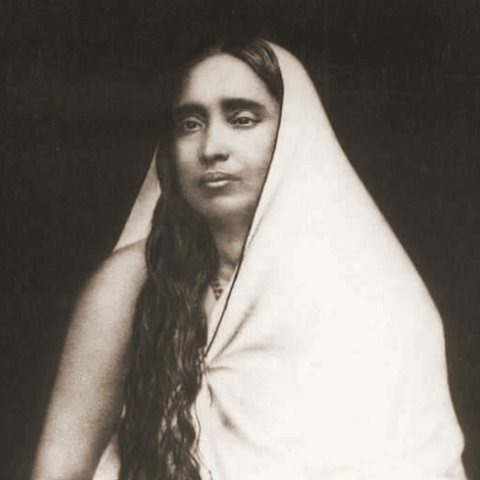
Over the next years he undertook a remarkable sequence of disciplines under different teachers: Tantra under the Bhairavi Brahmani, Vaishnava practice under Jatadhari, Advaita Vedanta under the wandering monk Totapuri, then Islam in 1866 and Christianity in 1873–74. From these he drew his central teaching: all sincere paths reach the same God. He had been married in 1859 to the five-year-old Saradamani; the marriage was never consummated, and he later worshipped her as the Divine Mother.
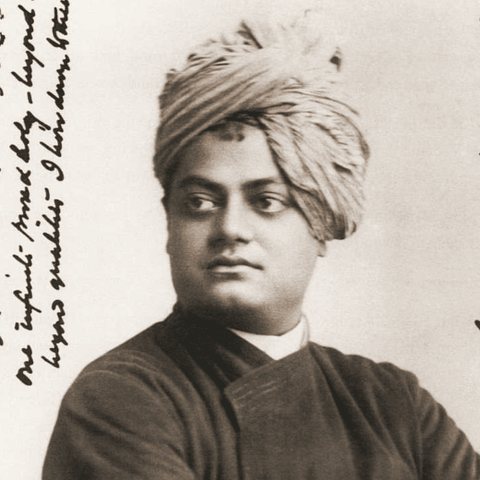
From the mid-1870s visitors streamed to Dakshineswar—Brahmo reformers, householders, and from 1881 the young Narendranath Datta, later Swami Vivekananda. He developed throat cancer in 1885 and died at the Cossipore garden house on 16 August 1886, aged fifty.
Quotations are from The Gospel of Sri Ramakrishna (Swami Nikhilananda's 1942 translation of M.'s Bengali Kathāmṛta) and from Tales and Parables of Sri Ramakrishna, as hosted at ramakrishnavivekananda.info, and from Belur Math's official site. The Bengali original is in the public domain; the Nikhilananda translation is not, and we reproduce only short attributed excerpts from it. The name and emblem of the Ramakrishna Math and Mission are legally protected and are not used here. This site is not affiliated with the Ramakrishna Math or Mission.