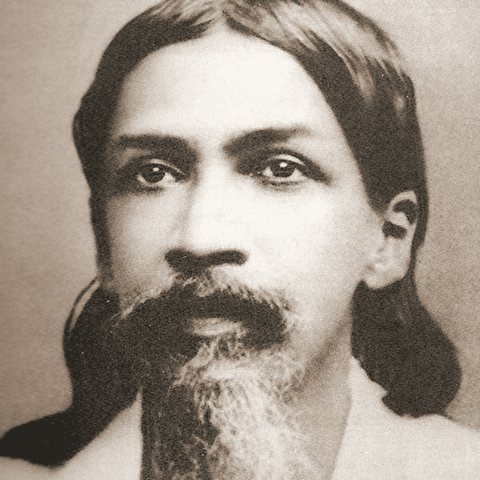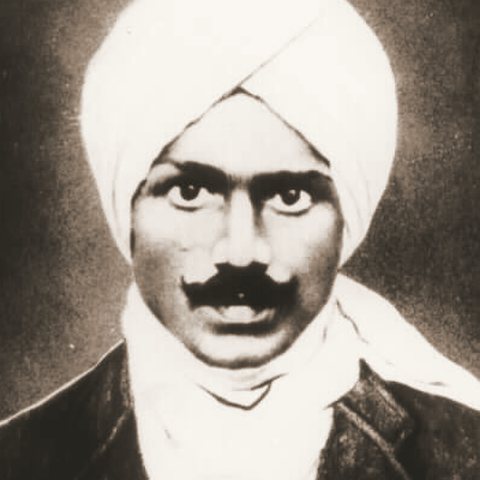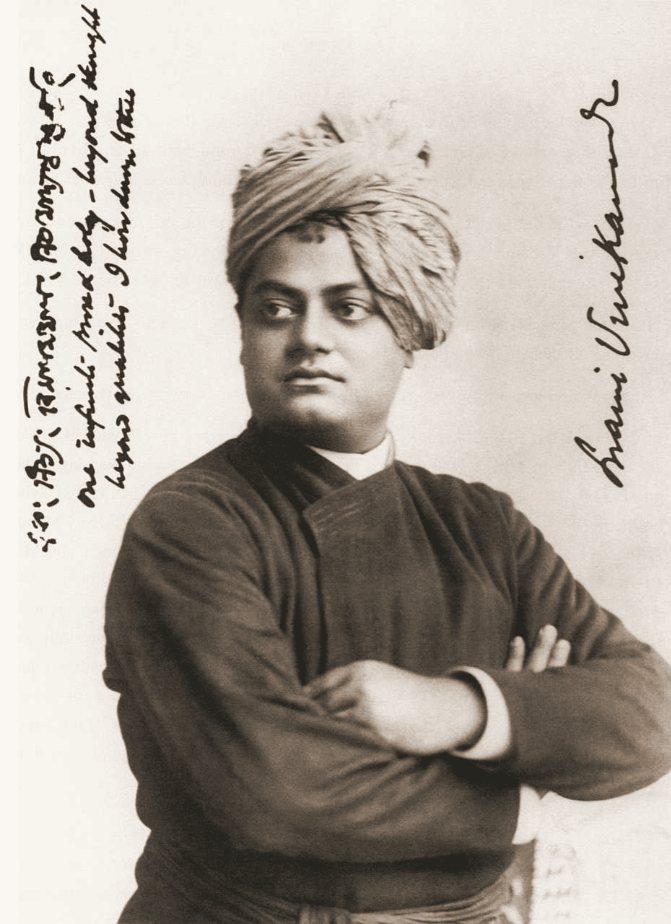
Swami Vivekananda in Chicago, September 1893, with his inscription: “One infinite pure and holy — beyond thought beyond qualities I bow down to thee.” Public domain, via Wikimedia Commons.
Swami Vivekananda
Who took Vedanta out of the forest and put it in the street
The sceptical law student who asked every teacher in Calcutta whether they had seen God, and was unsatisfied until he met Ramakrishna. After his master's death he walked the length of India for five years on alms, saw its poverty at close range, and came out with a conviction that would define him: religion that does not feed the hungry is not religion. In September 1893 he stood up at the World's Parliament of Religions in Chicago and began “Sisters and Brothers of America.”
His teaching is bracing. Strength, not consolation. Weakness is the only sin. Each soul is potentially divine and the whole of religion is to manifest it—by work, by love, by meditation, by knowledge, one or more or all. He founded the Ramakrishna Mission in 1897 with the motto “for one's own liberation and for the good of the world,” and died at thirty-nine.
“Each soul is potentially divine. The goal is to manifest this Divinity within by controlling nature, external and internal.”
Each soul is potentially divine
His one-sentence creed: the goal is to manifest this divinity within by controlling nature, external and internal—by work, or worship, or psychic control, or philosophy, by one or more or all of these. Doctrines, rituals, books and temples are secondary details. The soul is already perfect; practice only removes the covering.
Strength
He diagnosed weakness—physical, mental, moral—as the root pathology and fear as the thing to be eliminated. “Strength, strength is what the Upanishads speak to me from every page.” Hence his most misquoted line: that a young man would be nearer heaven through football than through the study of the Gita. He meant it: a weak body cannot hold a strong idea.
The four yogas
He systematised Ramakrishna's “many paths” into four routes suited to different temperaments: karma (unselfish work), bhakti (love), raja (meditation and control of the mind), jnana (discriminative knowledge). None is superior. Choose by constitution, and combine freely.
Service as worship
Shiva jnane jiva seva—service of the living being in the knowledge that it is God. The formula came from a remark of Ramakrishna's that one should not show compassion to beings but serve them as God. Vivekananda built an order on it. And he was clear about the direction of the debt: the beggar you help owes you nothing; you owe him, for letting you serve.
Religion is realisation
“Not talk, not doctrine, nor theories, however beautiful they may be.” He preferred an honest atheist to a superstitious believer, because “the atheist is alive.” Doubt is answered not by argument but by experiment: practise, observe, and see for yourself.
Each soul is potentially divine. The goal is to manifest this Divinity within by controlling nature, external and internal.
I am proud to belong to a religion which has taught the world both tolerance and universal acceptance.
Strength, strength is what the Upanishads speak to me from every page.
If there is sin, this is the only sin — to say that you are weak, or others are weak.
Never say, “No”, never say, “I cannot”, for you are infinite. Even time and space are as nothing compared with your nature.
He who has nothing to desire for himself, whom does he fear, and what can frighten him?
He works best who works without any motive, neither for money, nor for fame, nor for anything else.
Do not fly away from the wheels of the world-machine, but stand inside it and learn the secret of work.
The world is a grand moral gymnasium wherein we have all to take exercise so as to become stronger and stronger spiritually.
No beggar whom we have helped has ever owed a single cent to us; we owe everything to him, because he has allowed us to exercise our charity on him.
Helping others is only helping ourselves.
They alone live who live for others, the rest are more dead than alive.
If the room is dark, do you go about beating your chest and crying, “It is dark, dark, dark!” No, the only way to get the light is to strike a light.
It is not what you read, nor what dogmas you believe that is of importance, but what you realise.
Religion is realization; not talk, not doctrine, nor theories, however beautiful they may be.
I would rather see every one of you rank atheists than superstitious fools, for the atheist is alive.
Nothing is done in a day. Religion cannot be swallowed in the form of a pill. It requires hard and constant practice.
Really we do not develop our souls at all. What can develop the perfect? We simply take the evil off; and the soul manifests itself in its pristine purity.
Bhakti is intense love to God; when a man gets it, he loves all, hates none; he becomes satisfied for ever.
Whatever you think, that you will be. If you think yourselves weak, weak you will be.
Education is the manifestation of the perfection already in man.
By meditation you can make the mind subdue these waves, and if you go on practicing meditation for days, and months, and years, until it has become a habit, anger and hatred will be controlled and checked.
Give to the weak, for there all the gift is needed.
Arise, awake, and stop not till the goal is reached.
What fear has death for him? What fear has evil for him?
Vivekananda's sitting practice
- Practise twice a day, morning and evening. He said half an hour of each would “make you another person.”
- Sit erect, holding chest, neck and head in a straight line, in whatever posture is easiest for you.
- Before anything else, send goodwill outward. In his words: mentally repeat, “Let all beings be happy; let all beings be peaceful; let all beings be blissful.”
- Take a deep breath, fill the lungs, and slowly let it out. Continue slowly and rhythmically.
- Tell the body it is strong; tell the mind it is strong. Then sit in that strength, quietly, for the rest of the time.
- Expect nothing in a day. “It requires hard and constant practice.”
Service, in the right direction
- Find one small, concrete act of help you can do this week for someone who cannot repay you.
- Do it without telling anyone and without expecting thanks.
- Afterwards, reverse the usual accounting: they did you a favour by letting you serve. Sit with that for a minute. He held that this, repeated, is how the chains come off.
Born Narendranath Datta on 12 January 1863 in Calcutta into a prosperous, Westernised family, he took a BA in 1884, read widely in Western philosophy and science, and was intellectually restless and religiously sceptical. In November 1881 he met Ramakrishna at Dakshineswar. His father's death in 1884 left the family destitute and drove him closer to the master, whose disciple he became.
After Ramakrishna's death in 1886 he led the young disciples in taking monastic vows, and from 1888 travelled India for roughly five years as a wandering monk, living on alms. He sailed from Bombay on 31 May 1893 and on 11 September addressed the World's Parliament of Religions in Chicago. He lectured across the United States and England until 1896, founding the Vedanta Society of New York in 1894, and returned to India in January 1897.
On 1 May 1897 he founded the Ramakrishna Mission and in 1898 acquired the land at Belur for its headquarters. A second Western tour ran from 1899 to 1900. His health gave way, and he died at Belur Math on 4 July 1902, aged thirty-nine.
Swami Vivekananda's own words are in the public domain in India and the United States. Quotations are from the Complete Works of Swami Vivekananda as hosted at ramakrishnavivekananda.info, and from Belur Math's official site. The name and emblem of the Ramakrishna Math and Mission are legally protected and are not used here; this site is not affiliated with them.