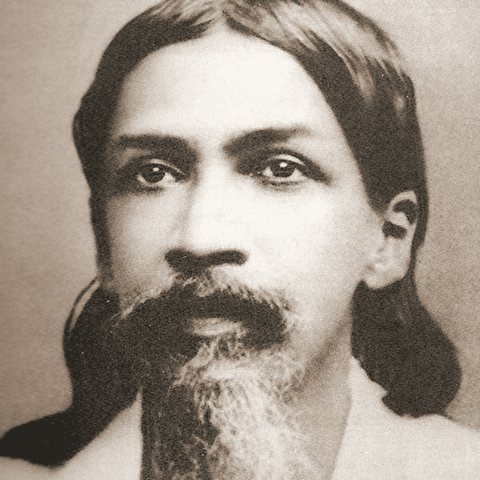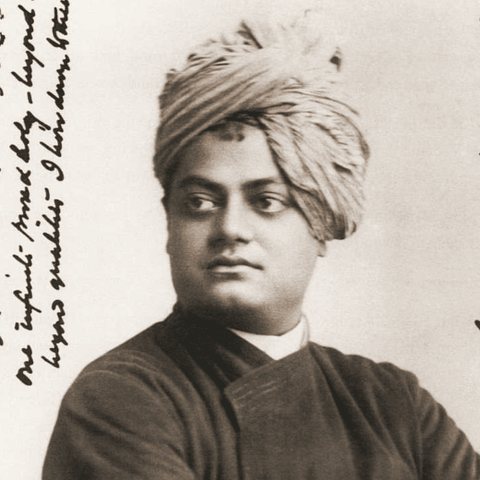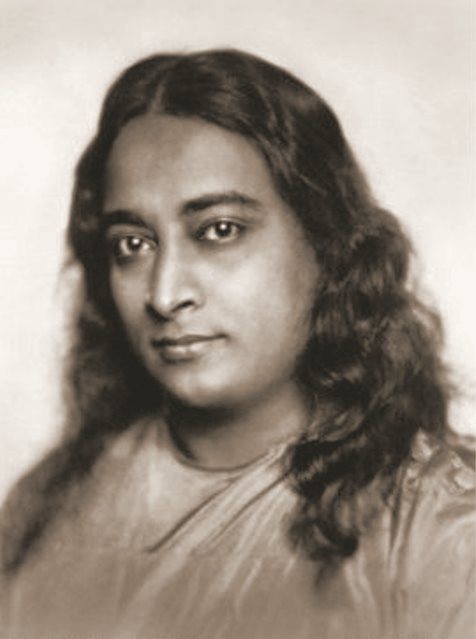
Paramahansa Yogananda, the “standard pose”, before 1946. Public domain, via Wikimedia Commons.
Paramahansa Yogananda
Who carried Kriya Yoga to the West and called it a science
A Bengali boy who ran away to the Himalayas repeatedly, found his guru at seventeen, sailed to Boston in 1920, and built in Los Angeles an organisation that taught meditation to hundreds of thousands. His Autobiography of a Yogi (1946) has never been out of print and is, by a wide margin, the most effective piece of writing ever produced for introducing Indian spirituality to readers outside India—warm, funny, full of saints, and absolutely sure of itself.
His method was Kriya Yoga, a breath-based technique transmitted through a lineage of four teachers, which he insisted was not a belief but a science: try it, observe, and see. Kriya itself is given only by initiation and we do not describe it here. What he taught publicly—affirmation, the direction of the will, courage in the face of fear and failure—is on this page.
“Look fear in the face and it will cease to trouble you.”
Religion as science
He presented the spiritual path as an experimental discipline with reproducible results. The point of a technique is not that you believe in it but that it works when applied. This is what made him legible to the America of the 1920s—and it is a genuine strand of the yoga tradition, not a marketing gloss.
Kriya Yoga and the lineage
Mahavatar Babaji to Lahiri Mahasaya to Sri Yukteswar to Yogananda. He defined Kriya as “union with the Infinite through a certain action or rite” and described it, in the language of his day, as a psychophysiological method. The technique is given only after preparation and initiation, and this site does not describe it, approximate it, or link to sites that do.
Affirmation
A distinctive contribution: the graded repetition of a chosen sentence—aloud, then softly, then whispered, then silently—until it moves from words into conviction. His published affirmations on health, fear and courage are among the most usable things in this library, and they require no initiation.
Fear, failure, will
“The season of failure is the best time for sowing the seeds of success.” “Always try once more.” “You are a child of God. What have you to fear?” His counsel is bracingly practical, and his guru's was sharper still: “Look fear in the face and it will cease to trouble you.”
Death
“Death is only an experience through which you are meant to learn a great lesson: you cannot die.” The soul is immortal and death a change of state; the structural argument of his autobiography is his guru's return after death to say so. He asked the bereaved not to grieve unreasonably, because extreme sorrow, he held, hinders the departed.
Look fear in the face and it will cease to trouble you.
Attachment is blinding; it lends an imaginary halo of attractiveness to the object of desire.
So long as you breathe the free air of earth, you are under obligation to render grateful service.
The body is a treacherous friend. Give it its due; no more.
Pain and pleasure are transitory; endure all dualities with calmness, while trying at the same time to remove their hold.
Wrath springs only from thwarted desires. I do not expect anything from others, so their actions cannot be in opposition to wishes of mine.
You must not get overdrunk with ecstasy. Much work yet remains for you in the world.
Though the ordinary man looks upon death with dread and sadness, those who have gone before know it as a wondrous experience of peace and freedom.
When death comes, laugh at it. Death is only an experience through which you are meant to learn a great lesson: you cannot die.
When a dear one dies, instead of grieving unreasonably, realize that he has gone on to a higher plane at the will of God.
You are a child of God. What have you to fear?
Meet everybody and every circumstance on the battlefield of life with the courage of a hero and the smile of a conqueror.
Anger defeats the very purpose for which it is aroused. Anger is not an antidote for anger.
Absence of wrath is the quickest way to peace of mind.
The season of failure is the best time for sowing the seeds of success.
Always try once more, no matter how many times you have failed.
Man has come on earth solely to learn to know God; he is here for no other reason.
The more you depend upon conditions outside yourself for happiness, the less happiness you will experience.
Happiness lies in making others happy, in forsaking self-interest to bring joy to others.
You are not forsaken. It is you who have forsaken your Self.
Forgiveness is the might of the mighty; forgiveness is sacrifice; forgiveness is quiet of mind.
Our real self, the soul, is immortal. We may sleep for a little while in that change called death, but we can never be destroyed.
Imagination is the door through which disease as well as healing enters.
Affirmation, four ways down
- On waking or before sleep, sit erect with eyes closed and attention at the point between the eyebrows.
- Choose one published affirmation. YSS offers, for example: “God is within and around me, protecting me; so I will banish the fear that shuts out His guiding light.”
- Repeat it aloud several times. Then softly. Then in a whisper. Then only in the mind, until, in his words, you reach deep, unbroken concentration.
- The movement is from words to conviction. Do not skip stages.
Slow breath against dread
- He wrote that fear comes from the heart, and that when dread of illness or accident overwhelms you, you should “inhale and exhale deeply, slowly, and rhythmically.”
- Do exactly that for two minutes. Nothing more elaborate. No visualisation, no counting, no reference to energy or the spine.
- This is not Kriya and is not a step toward it. It is a calming practice he published for anyone.
Born Mukunda Lal Ghosh on 5 January 1893 in Gorakhpur, into a Bengali family whose parents were both disciples of Lahiri Mahasaya, he lost his mother at eleven—an event he places at the centre of his autobiography. His adolescence was a sequence of flights toward the Himalayas and encounters with saints. In 1910, at seventeen, he met Swami Sri Yukteswar Giri at Serampore and became his disciple, living in his ashram for the next decade. He graduated from Serampore College in 1915, took vows in the Swami Order, and in 1917 founded a boys' school that became the seed of Yogoda Satsanga Society of India.
In 1920 he sailed to Boston to address a congress of religious liberals and founded Self-Realization Fellowship the same year. He remained in the United States for the rest of his life apart from one return to India in 1935–36, during which Sri Yukteswar conferred on him the title Paramahansa. He lectured to very large audiences, established headquarters on Mount Washington in Los Angeles, and taught Kriya Yoga as a reproducible discipline rather than a matter of belief.
Autobiography of a Yogi was published in December 1946. He died on 7 March 1952 in Los Angeles, at a banquet for the Indian ambassador, immediately after delivering a short speech.
Quotations from Autobiography of a Yogi are from the 1946 first edition, which is in the public domain in the United States and which Crystal Clarity Publishers and Project Gutenberg reproduce in full; later SRF editions are in copyright. Other quotations are as published by Self-Realization Fellowship and Yogoda Satsanga Society on their own websites, which cite the source books only collectively, and we reproduce them briefly under fair use with attribution. Kriya Yoga and SRF's meditation techniques are taught only through their Lessons, and we do not describe them. This site is not affiliated with SRF or YSS.