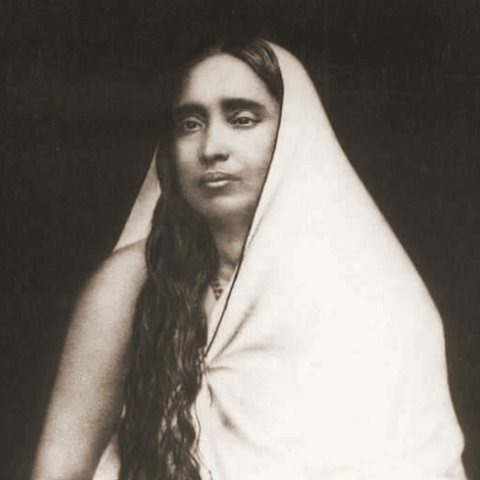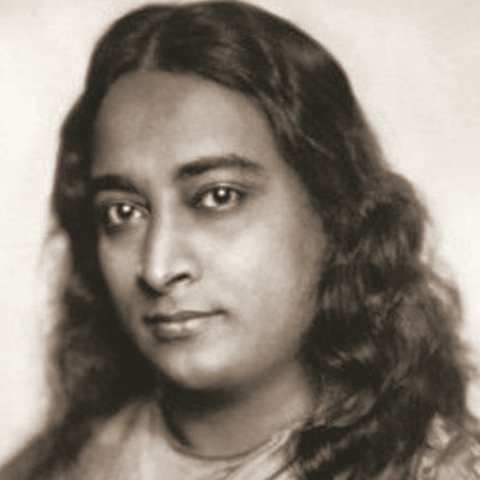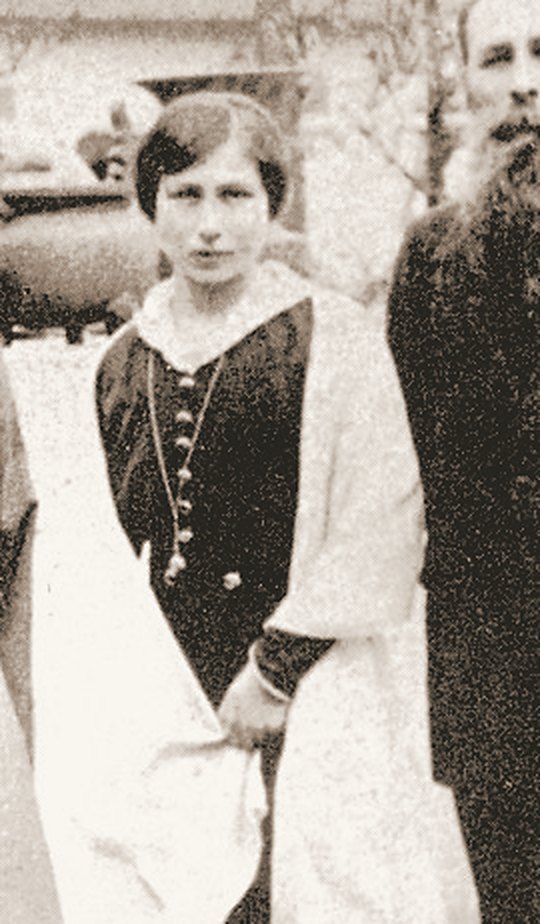
Mirra Alfassa — the Mother — in Japan, June 1916, photographed with Rabindranath Tagore and Paul Richard. Public domain, via Wikimedia Commons.
The Mother
Mirra Alfassa — collaborator of Sri Aurobindo, founder of Auroville
A Parisian painter and pianist who trained in occultism in Algeria, kept a spiritual diary of astonishing intimacy, recognised Sri Aurobindo on sight in 1914 as the figure of her visions, and from 1926 carried the whole material and spiritual charge of his Ashram for nearly fifty years. The Mother's teaching is less a philosophy than a set of instructions from someone who had to make a community of thousands actually work.
That is why it is so usable. On fear, on illness, on sleep, on difficulty, on the aim of a life—she answers the way a doctor answers, briefly and to the point. She founded Auroville in 1968 as a place that would “belong to humanity as a whole.”
“Never forget that you are not alone. The Divine is with you helping and guiding you. He is the companion who never fails, the friend whose love comforts and strengthens.”
Work is yoga
“I make no difference between work and yoga,” she wrote. Work done in a spirit of dedication and surrender is not a distraction from spiritual life but its fastest engine—she claimed one could progress ten times more through work in the right spirit than through meditation alone. The condition is the spirit, not the task: cooking, accounts, carpentry and teaching were all sadhana in her Ashram.
Have an aim
Her educational writing begins not with technique but with direction: an aimless life is always a miserable life, and the quality of a life depends on the quality of its aim. The highest aim she proposed is to find the truth of one's own being and unite with it—but she was clear that any real aim, held steadily, is better than drifting.
Fear as the root of trouble
She treated fear as a physical fact, not a moral failing—an instinct lodged in the body that attracts what it fears and, she claimed, underlies most illness. Her advice is never to argue with fear but to shift one's support: to stand on the Divine rather than on one's own strength, and to remember that one is never alone.
Difficulties are for the strong
Difficulty, in her view, is not a sign that something has gone wrong; it is sent to make the realisation more perfect. The dangerous thing is not the difficulty but thinking about it—“never think of a difficulty, you give it strength.” Overcoming one, she said, always begins a new opening.
Death and the departed
Life is immortal; only the body dissolves. What one loved in a person is untouched by the dissolution of the material envelope. She asked the bereaved not to stop loving but to stop sorrowing—because sorrow, she believed, disturbs the departed on their way—and to keep instead a peaceful, affectionate remembrance.
Never forget that you are not alone. The Divine is with you helping and guiding you. He is the companion who never fails, the friend whose love comforts and strengthens.
An aimless life is always a miserable life. Every one of you should have an aim. But do not forget that on the quality of your aim will depend the quality of your life.
I make no difference between work and yoga. Work itself is yoga if it is done in a spirit of dedication and surrender.
Work done in the true spirit is meditation.
Difficulties are sent to us exclusively to make the realisation more perfect.
The difficulties are for the strong, and help to make them stronger.
Never think of a difficulty—you give it strength.
Life is immortal. It is only the body that dissolves.
Have no sorrow and remain very peaceful and quiet, while keeping an affectionate remembrance of the one who has departed.
Most of your troubles come from fear. In fact, ninety per cent of illnesses are the result of the subconscient fear of the body.
Offered as her observation, not as medical advice. See our note on illness.
Fear is always a very bad adviser.
Doubt is not a sport to indulge in with impunity; it is a poison which drop by drop corrodes the soul.
The Grace is always there ready to act but you must let it work and not resist its action. The one condition required is faith.
It is our lack of faith that creates our limitations.
Good health is the exterior expression of an inner harmony.
At the time of lying down one should always begin by quieting one's thoughts.
Always when one faces difficulties and overcomes them it begins a new spiritual opening and victory.
The Divine alone is the support that never fails.
Whatever you do, whatever your occupations and activities, the will to find the truth of your being and to unite with it must be always living and present behind all that you do.
I aspire for the day when I can no longer say “I”, for I shall be Thou.
Glory to Thee, O Lord, who triumphest over every obstacle. Grant that nothing in us shall be an obstacle in Thy work. Grant that nothing may retard Thy manifestation. Grant that Thy will may be done in all things and at every moment.
It never does any harm to express an aspiration—that gives force to it.
Auroville belongs to nobody in particular. Auroville belongs to humanity as a whole.
Going to sleep
- Lie down and relax the body deliberately—every limb, the face, the hands—until it is fully at ease.
- Quiet the thoughts. She says this should always be the first thing, before anything else.
- Then, with whatever sincerity you have, offer yourself in that relaxation—let go of the day into something larger than yourself.
- On waking, stay still a moment before moving. The night's dreams are often retrievable then, and she held that one can learn much from them.
Working in the true spirit
- Choose any ordinary task of the day—not a special one.
- Do it with full attention and care for its perfection, as if it mattered absolutely, while holding inside a quiet remembrance of what you are doing it for.
- Expect nothing back—no thanks, no result. Let the doing be the offering.
- Notice afterwards whether the mind is quieter than it was. That, she says, is meditation.
Born Mirra Alfassa in Paris on 21 February 1878, to a Turkish-Jewish father and an Egyptian-Jewish mother, she trained at the Académie Julian and became an accomplished painter and pianist, moving in the circles of Rodin and Monet. From childhood she had inner experiences she could not explain. In 1905–06 she travelled to Tlemcen in Algeria to study occultism with Max Théon, and from 1912 kept the spiritual diary later published as Prayers and Meditations.
In 1914 she came to Pondicherry, met Sri Aurobindo, and co-founded the review Arya with him; the war forced her back to France, then to Japan for four years. She returned to Pondicherry in April 1920 and never left. When the Ashram was formed in November 1926, Sri Aurobindo entrusted its full charge to her.
She founded the Sri Aurobindo International Centre of Education in 1952 and the international township of Auroville in 1968, whose Charter she wrote. In her last years she recorded with Satprem the conversations published as Mother's Agenda. She left her body on 17 November 1973.
All quotations are from the Collected Works of the Mother, in the Ashram's English translation, as published online by the Sri Aurobindo Ashram Trust. The Mother's works remain in copyright (in India until 2034, and later for posthumously published and translated material). We reproduce only short attributed excerpts, link every one to its chapter, and do not host any full text or audio. The Ashram makes her organ music and readings freely available for personal listening on its own site; see our Listen page. This site is not affiliated with or endorsed by the Sri Aurobindo Ashram.